I believe that if you ask any business owner how they get their best clients, the most common answer you will hear is: “word of mouth.” Long before the internet, search engine algorithms, or paid social media ads, businesses survived and thrived simply because one happy customer told another. But in today’s digital age, this age-old phenomenon has evolved into a structured, highly strategic discipline.
Understanding what is word of mouth marketing (often abbreviated as WOMM) and knowing how to actively trigger it is the difference between waiting around for accidental referrals and building a predictable growth engine. In my opinion, it is the most cost-effective and powerful form of marketing available to startups and businesses. In this guide, I will break down how word of mouth marketing works, why it is so effective, and how you can actively encourage your customers to spread the word about your brand.
Table of Contents
- What is Word of Mouth Marketing?
- Organic vs. Amplified Word of Mouth
- Why Word of Mouth is So Powerful
- Strategies to Trigger Word of Mouth Marketing
- Frequently Asked Questions
- Conclusion
What is Word of Mouth Marketing?
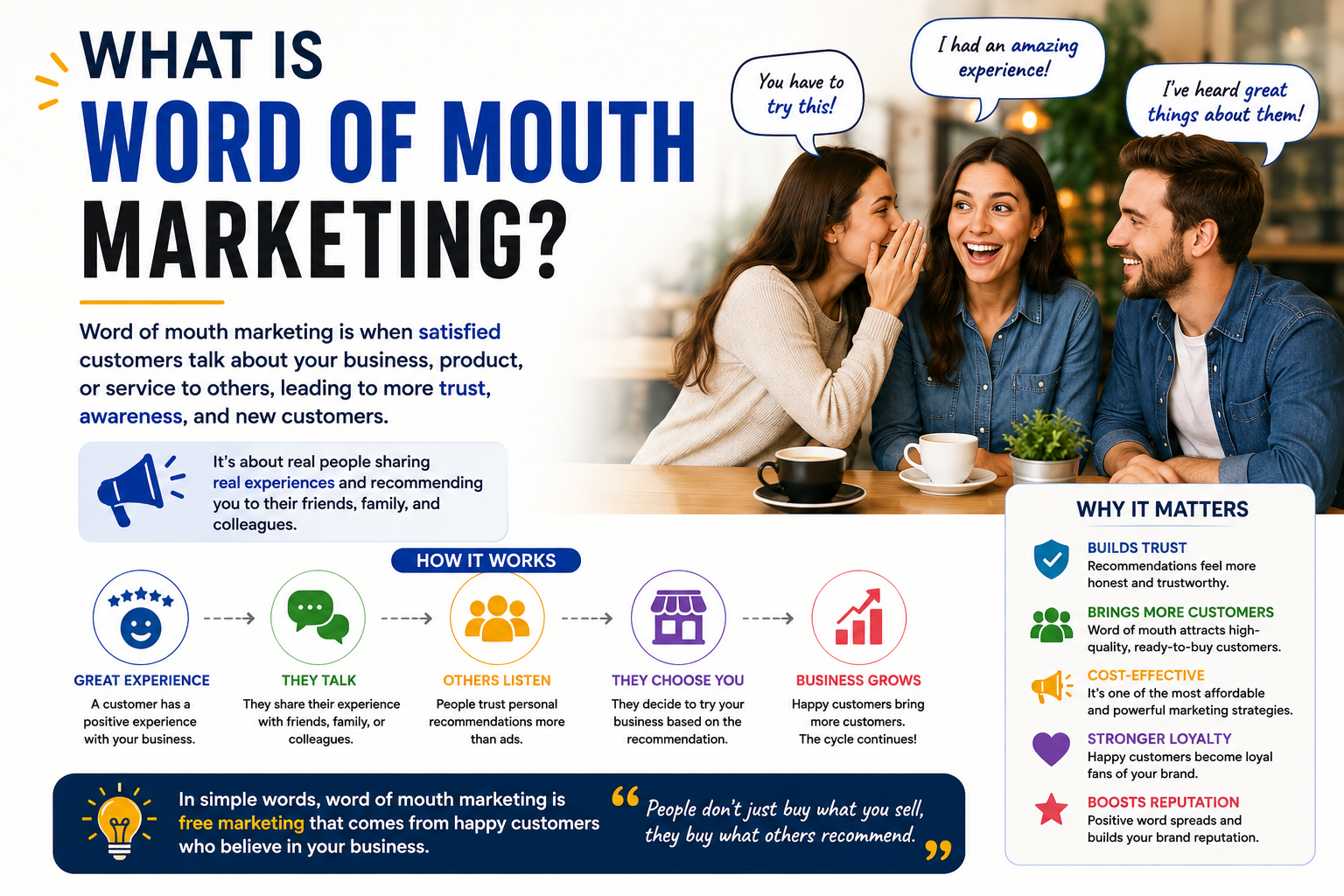
At its core, word of mouth marketing is the active encouragement and stimulation of organic discussions, recommendations, and shares about a product, service, or brand. It occurs when a customer’s interest in a business’s offering is reflected in their daily dialogues with friends, family, or colleagues. In my view, it is not just about making a sale; it is about creating an experience so remarkable that customers feel compelled to share it with their social circles.
In the past, this happened exclusively via face-to-face conversations or phone calls. Today, word of mouth is largely digital. When a customer posts an unboxing video on Instagram, leaves a detailed review on Google Maps, shares a product link in a WhatsApp group, or tweets about a great customer support interaction, they are participating in digital word of mouth marketing.
Organic vs. Amplified Word of Mouth
To implement this strategy successfully, I believe it is important to distinguish between the two main types of word of mouth:
- Organic Word of Mouth: This happens naturally when customers become advocates because they are happy with a product and have a natural desire to share their satisfaction. The business does not directly intervene to prompt this conversation; it simply delivers outstanding value.
- Amplified Word of Mouth: This occurs when a business launches campaigns designed to encourage or accelerate recommendations. Examples include setting up a refer-a-friend program, collaborating with local micro-influencers, hosting community events, or launching viral social media campaigns.
In my opinion, while organic word of mouth is the ideal foundation, smart businesses use amplified tactics to speed up the process and reach new audiences systematically.
Why Word of Mouth is So Powerful
I believe the power of word of mouth comes down to one single word: trust. Consumers have become increasingly skeptical of traditional advertising. When a brand tells you their product is the best in a paid TV ad or a sponsored post, you naturally take it with a grain of salt. But when your sibling, close friend, or even a neutral reviewer online recommends a product, you believe them. They have no financial incentive to lie to you, which makes their recommendation highly credible.
Additionally, word of mouth is incredibly cost-efficient. Traditional ad campaigns require constant cash flow—the moment you stop paying for ads, the leads dry up. Word of mouth, on the other hand, builds compounding value. A single customer who advocates for your brand can bring in three new customers, who in turn bring in more. This organic loop dramatically lowers your customer acquisition costs.
Strategies to Trigger Word of Mouth Marketing
You cannot simply sit back and hope people talk about your business. I believe you must design a customer journey that naturally encourages sharing. Here are the most effective strategies to trigger word of mouth:
- Deliver an Over-the-Top Experience: The absolute baseline of word of mouth is exceeding expectations. If you only deliver what was promised, customers are satisfied, but they won’t talk. If you deliver something unexpected—like a handwritten note, incredibly fast delivery, or a surprise freebie—they will tell their friends.
- Incentivize Referrals: Create a structured referral program where both the existing customer and the new customer get a reward (such as a discount or free service). This gives satisfied clients a gentle nudge to actively recommend your business.
- Encourage User-Generated Content (UGC): Make your product or service “shareable.” For physical products, design premium, beautiful packaging that makes customers want to record an unboxing video for their social media. For services, create milestone achievements or beautiful visual results that clients want to screenshot and share.
- Build a Community: Leverage social media groups, email newsletters, or local events to bring your customers together. When customers feel like they belong to a community or a shared movement, they naturally become passionate advocates for the brand.
- Highlight Social Proof: When you receive positive feedback, share it publicly. Screenshot nice text messages (with permission), display reviews on your website, and thank clients publicly for their support. This shows others that your brand is actively discussed and appreciated.
Frequently Asked Questions
Q1. Is word of mouth marketing completely free?
Organic word of mouth is free since it relies on customers sharing their thoughts naturally. However, amplified word of mouth marketing—such as setting up referral software, giving out discount incentives, or hosting customer appreciation events—involves minor setup costs. In my opinion, these costs are negligible compared to paid advertising.
Q2. What is the difference between referral marketing and word of mouth marketing?
I view referral marketing as a structured subset of word of mouth. Word of mouth is the general act of people sharing opinions about your brand. Referral marketing is a formalized trackable program where a business actively rewards customers for directly bringing in new clients.
Q3. How do you measure word of mouth marketing?
The simplest way is to ask every new customer during inquiry: “How did you hear about us?” You can also track referral link clicks, monitor mentions of your brand name on social media, and look at the growth of your direct search traffic on Google.
Q4. Can negative word of mouth destroy a business?
Yes, negative word of mouth spreads much faster than positive feedback. In my view, the best way to handle negative word of mouth is to address complaints immediately, apologize sincerely, and resolve the issue publicly. Turning a bad experience into a great resolution can actually win you a loyal advocate.
Q5. How long does it take for word of mouth marketing to show results?
Unlike paid ads that can generate clicks in minutes, word of mouth is a long-term strategy. It requires time to build a base of satisfied customers who then share their experiences. I believe you should expect to see consistent referral loops forming over a period of three to six months.
Q6. Can online e-commerce stores rely on word of mouth?
Absolutely. E-commerce stores thrive on digital word of mouth. You can encourage this by prompting customers to leave photo/video reviews, offering reward points for social shares, and ensuring your packaging is highly photogenic for social media unboxings.
Q7. What is viral marketing, and is it the same as word of mouth?
I look at viral marketing as a hyper-accelerated form of word of mouth. Word of mouth is usually a steady, personal recommendation between small groups. Viral marketing is a campaign designed to spread exponentially to millions of people online in a very short window, often driven by humor or high emotional appeal.
Q8. How do you get customers to start talking about your service?
In my opinion, the easiest way is to ask. When a customer compliments your service, tell them: “I’m so glad you’re happy! We rely heavily on word of mouth, so if you have friends who need this service, please send them our way.” Most happy clients are glad to help.
Q9. Do incentives (like discounts) make word of mouth feel fake?
Not if the customer already loves your product. An incentive simply acts as a trigger to get them to share sooner. However, if your product is poor, offering large incentives won’t help, as customers will not risk their personal reputation to recommend a bad service just for a discount.
Q10. How do online reviews relate to word of mouth marketing?
Online reviews are the modern, written version of word of mouth. When a potential customer reads Google Maps or Yelp reviews from strangers, they treat them as personal recommendations. Optimizing and requesting online reviews is a vital part of any digital word-of-mouth strategy.
Conclusion
Understanding what is word of mouth marketing is essential for any business looking to scale sustainably. Paid advertising can bring customers to your door, but it is the quality of your product and customer experience that turns them into raving fans. By delivering exceptional value and giving your customers the tools and incentives to share, you can build a self-sustaining marketing engine that grows your brand organically.
Start by focusing on one small surprise element in your service today that makes a customer say “wow.” That single reaction is the seed of your next great referral loop.
If you are trying to build a referral network or want ideas on how to encourage reviews, feel free to share your thoughts. In my opinion, establishing a strong customer experience first is the absolute key to triggering word of mouth.