I believe that if you ask ten different business owners to define marketing, you will likely get ten different answers. Some will tell you it’s about running ads on social media, others will say it’s about cold calling and sales, and some will associate it entirely with branding and logos. While all of these elements are parts of the puzzle, none of them represent the full picture on their own.
Understanding what is marketing in its entirety is the first step to building a successful, sustainable business. It is not just a single department or a set of campaigns; it is a holistic process that begins before a product is even created and continues long after the sale is complete. In this guide, I will share my perspective, break down the core pillars of marketing, and explain how different marketing channels work together to drive business growth.
Table of Contents
- What is Marketing?
- Marketing vs. Sales vs. Advertising
- The Four Ps of Marketing
- Key Types of Marketing Channels
- Inbound vs. Outbound Marketing Comparison
- Frequently Asked Questions
- Conclusion
What is Marketing?
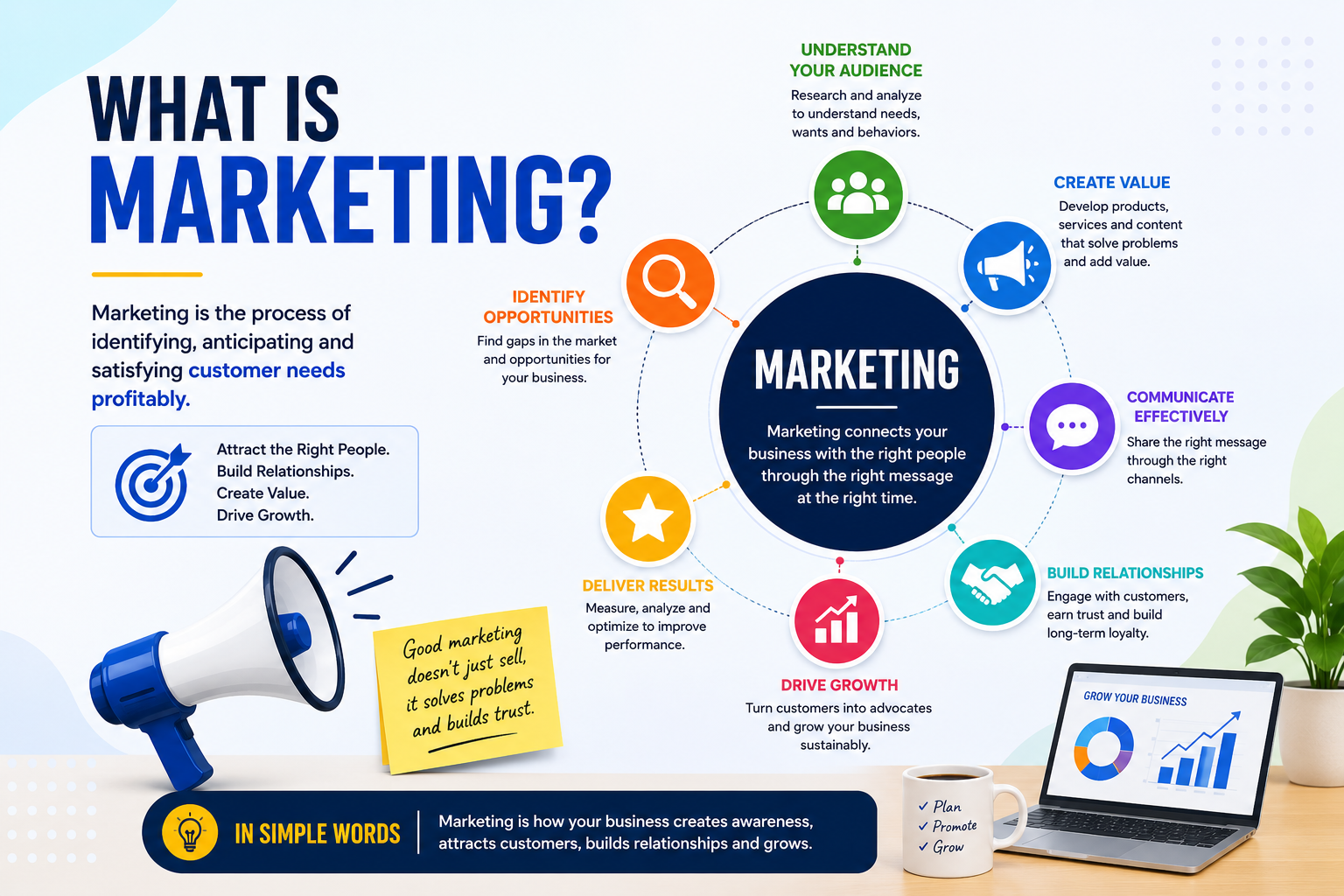
At its core, marketing is the process of getting people interested in your business’s product or service. This is achieved through market research, analysis, and a deep understanding of your target customer’s needs and interests. In my opinion, marketing encompasses everything a company does to acquire customers and maintain relationships with them.
I look at marketing as a matchmaker. Your business has a solution, and somewhere out there is a customer with a problem. Marketing is the entire ecosystem of communication, branding, pricing, and distribution that brings the two together. It is about delivering the right message to the right person at the right time, helping them understand how your product can improve their lives.
Marketing vs. Sales vs. Advertising
In my experience, people often use the terms marketing, sales, and advertising interchangeably. However, they are distinct disciplines with different goals:
- Marketing: This is the broad, overarching strategy. It includes identifying customer needs, designing the product, setting the price, choosing the distribution channels, and promoting the product. It sets the stage for the customer journey.
- Advertising: This is a specific component of marketing. It is the paid communication designed to spread awareness about a product or service. Examples include Facebook ads, Google search ads, billboards, and print advertisements.
- Sales: This is the final step of the marketing process. It focuses on converting the interested leads generated by marketing into paying customers through direct interaction, negotiations, and closing deals.
In short, marketing builds interest and brings prospects to your door, advertising is the megaphone that tells them you exist, and sales closes the transaction.
The Four Ps of Marketing
To understand how marketing works in practice, I suggest looking at the classic framework known as the “Four Ps.” Developed in the 1960s, this model still serves as the foundation for modern marketing strategies:
- Product: What are you selling? This involves designing a product or service that solves a specific customer problem. Marketing helps determine what features, sizes, and packaging your target audience wants.
- Price: How much does it cost? Pricing is a powerful marketing signal. A price that is too low can signal poor quality, while a price that is too high can alienate customers. Marketers evaluate competitor pricing and customer willingness to pay to find the sweet spot.
- Place: Where is it sold? This refers to the distribution channels. Will you sell online via your website, through third-party e-commerce platforms, or in physical retail stores? Placing your product where your target customers shop is vital.
- Promotion: How do customers find out about it? This includes all the tactics used to communicate the product’s benefits—such as social media marketing, public relations, email campaigns, search engine optimization, and advertising.
Key Types of Marketing Channels
Modern marketing is generally divided into two major strategies: Inbound and Outbound marketing. In my opinion, the most successful businesses use a healthy mix of both to maximize their reach.
- Inbound Marketing: This strategy focuses on “pulling” customers in. Instead of interrupting people with ads, you create valuable content (like blog posts, videos, and social media tips) that solves their problems. When they search for solutions on Google or YouTube, they find your helpful content and organically discover your brand.
- Outbound Marketing: This is the traditional “push” strategy. It involves reaching out to a broad audience to introduce your product, whether they are actively looking for it or not. Examples include television commercials, print ads, cold emailing, and trade show booths.
Inbound vs. Outbound Marketing Comparison
To help you decide where to invest your marketing budget, I have put together a comparison table showing the key differences between these two strategies.
| Feature | Inbound Marketing (Pull Strategy) | Outbound Marketing (Push Strategy) |
|---|---|---|
| Customer Interaction | Customers seek out your business when they need help. | Business initiates contact and interrupts the audience. |
| Core Channels | SEO, Content Marketing, Social Media, Opt-in Email Lists. | TV/Radio Ads, Billboard Ads, Cold Outreach, Banner Ads. |
| Cost Efficiency | Highly cost-effective; builds long-term organic assets. | Often expensive; costs are recurring to maintain visibility. |
| Timing | Generates long-term, compounding results over time. | Generates immediate, short-term attention and traffic. |
| Audience Intent | High-intent; users are actively searching for a solution. | Low-intent; audience may not be interested in your offer. |
Frequently Asked Questions
Q1. Is marketing and advertising the same thing?
No, they are not. In my view, marketing is the complete umbrella strategy that covers product research, pricing, distribution, and promotion. Advertising is just one specific tool under that promotional umbrella that involves paying to place your brand message in front of an audience.
Q2. Can a business survive without marketing?
I believe that without marketing, a business cannot survive long-term. Even if you have the best product in the world, you cannot make sales if nobody knows you exist. Marketing is the process that ensures a steady flow of new customers and keeps your current clients engaged.
Q3. What is the most effective type of marketing today?
In my opinion, there is no single “best” type of marketing. The most effective strategy depends entirely on where your target audience spends their time. For digital services, content marketing and search engine optimization (SEO) are highly effective. For local retail shops, local map directories and community promotions work best.
Q4. Is digital marketing better than traditional marketing?
Digital marketing offers major advantages, such as precise targeting, lower costs, and real-time performance tracking. However, traditional marketing (like print ads or local signs) can still be highly effective for reaching local demographics who may not be highly active online. A balanced approach is usually the most successful.
Q5. How do I start marketing my new business on a budget?
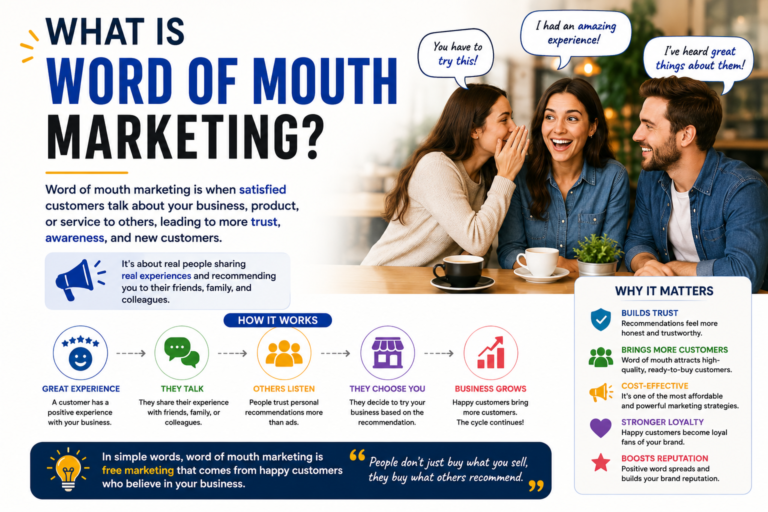
I suggest starting with organic digital channels. Create a free business listing on local search directories, start a professional social media profile to share valuable tips, optimize your website content for search engines, and leverage word-of-mouth by delivering an exceptional customer experience.
Q6. What is the difference between marketing and branding?
Branding is the identity, personality, and values of your business (who you are), while marketing is the collection of tactics and tools you use to communicate that brand message (how you get customers to notice you).
Q7. What is social proof, and why is it important in marketing?
Social proof refers to testimonials, reviews, ratings, and endorsements from other customers. It is crucial because customers trust recommendations from their peers far more than a brand’s self-advertisements.
Q8. How do I define my target audience?
I suggest analyzing your product’s core value and identifying who benefits from it most. Create user personas based on demographics (age, location, income) and psychographics (challenges, desires, interests) to tailor your messaging.
Q9. What is SEO and how does it relate to marketing?
SEO (Search Engine Optimization) is the process of optimizing your website content so it ranks higher in organic search results. It is a vital inbound marketing strategy because it brings high-intent searchers to your website without paid advertising.
Q10. How long does it take for marketing efforts to show results?
It depends on the channel. Paid advertising can yield clicks and leads immediately, whereas organic strategies like content marketing and search engine optimization (SEO) typically require three to six months to build momentum and show consistent results.
Conclusion
Understanding what is marketing is the key to moving your business from a passive bystander to an active market participant. It is the strategic process of aligning your products, prices, distribution channels, and promotional messages with the real needs of your customers. By viewing marketing as an investment in relationship building rather than a simple expense, you can create a sustainable engine that drives brand awareness and consistent sales.
Begin by identifying your target customer’s primary pain point today, and structure your messaging around how your business can solve it. That clarity is the foundation of all successful marketing campaigns.
If you are planning to build a marketing plan or want feedback on your current promotional strategies, feel free to share your thoughts. In my opinion, starting with a clear value proposition is the best way to ensure marketing success.