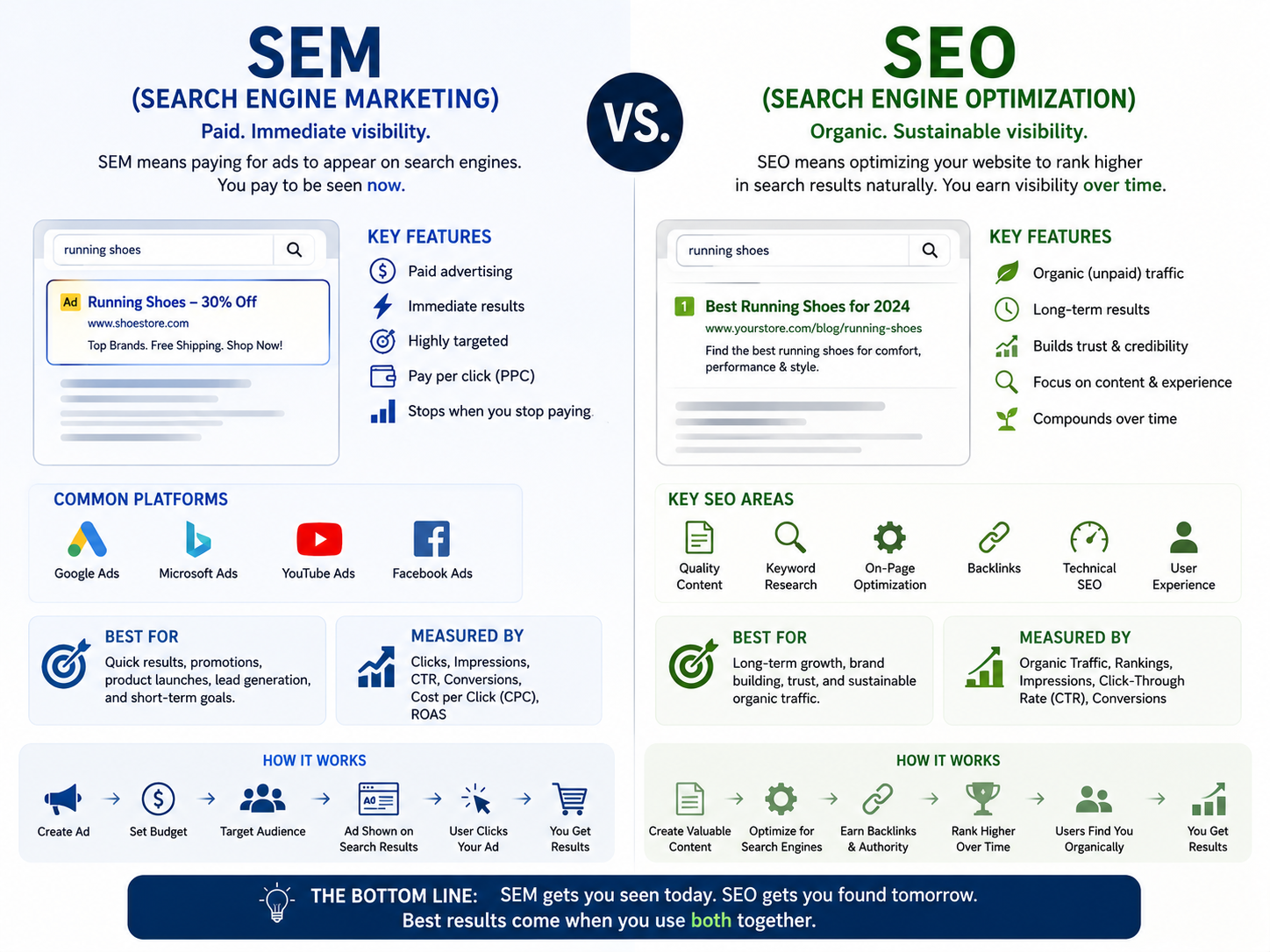
If I want my website to appear on the first page of Google, two of the most effective digital marketing strategies I can use are Search Engine Optimization (SEO) and Search Engine Marketing (SEM). Although these terms are often used together, they represent different approaches to increasing search engine visibility. Understanding SEM vs SEO helps me choose the right strategy based on my budget, business goals, competition, and desired results.SEO focuses on improving my website’s organic rankings through high-quality content, technical optimization, and authority building, while SEM uses paid advertising to place my website at the top of search engine results almost instantly. Both strategies are valuable, and many successful businesses combine them to maximize online visibility and return on investment (ROI).In this comprehensive guide, I’ll explain the differences between SEM and SEO, compare their features, advantages, disadvantages, costs, and performance, and help determine which strategy is best for different business situations.
Table of Contents
What is SEO?
Search Engine Optimization (SEO) is the process of improving my website so it ranks higher in organic (non-paid) search engine results. SEO focuses on increasing website visibility naturally by optimizing content, keywords, technical performance, backlinks, and user experience.
Unlike paid advertising, SEO does not require payment for every click. Instead, I invest time and effort into creating valuable content and optimizing my website to earn higher rankings over time.
Main Components of SEO
- Keyword research
- On-page SEO
- Off-page SEO
- Technical SEO
- Local SEO
- Content optimization
- Link building
- Website performance optimization
What is SEM?
Search Engine Marketing (SEM) is a digital marketing strategy that increases website visibility through paid advertisements on search engines. SEM usually involves Pay-Per-Click (PPC) advertising platforms such as Google Ads, where I bid on keywords to display my ads above organic search results.
With SEM, I can reach potential customers immediately, target specific audiences, and measure campaign performance using detailed analytics.
Main Components of SEM
- Google Ads campaigns
- Keyword bidding
- Pay-Per-Click (PPC)
- Ad copy optimization
- Landing page optimization
- Audience targeting
- Conversion tracking
- Campaign analytics
SEM vs SEO: Key Differences
The primary difference between SEM and SEO is that SEO generates free organic traffic by improving search rankings naturally, whereas SEM generates paid traffic by displaying advertisements in search results.
SEO requires patience because rankings improve gradually, while SEM delivers immediate visibility as soon as advertising campaigns begin. However, SEM requires continuous advertising budgets, whereas SEO continues generating traffic even after optimization efforts are complete.
SEM vs SEO Comparison Table
| Comparison Factor | SEO | SEM |
|---|---|---|
| Traffic Source | Organic search results | Paid advertisements |
| Cost | No cost per click | Pay for every click |
| Results | Long-term | Immediate |
| Investment | Time and optimization | Advertising budget |
| Ranking Position | Organic listings | Sponsored listings |
| Traffic Sustainability | Long-lasting | Stops when ads stop |
| Click Cost | Free | Paid per click |
| Competition | Based on SEO quality | Based on bidding and quality score |
| Best For | Long-term growth | Fast visibility |
| ROI Timeline | Several months | Almost immediate |
Advantages of SEO
SEO offers sustainable growth by helping my website earn consistent organic traffic over time.
- Free organic traffic.
- Higher credibility among users.
- Long-term visibility.
- Improves website authority.
- Enhances user experience.
- Supports brand awareness.
- Higher long-term return on investment.
- Works continuously without paying for each visitor.
Advantages of SEM
SEM provides immediate visibility and allows me to reach highly targeted audiences through paid campaigns.
- Instant search engine visibility.
- Highly targeted audience selection.
- Fast lead generation.
- Flexible advertising budgets.
- Detailed performance tracking.
- Easy campaign optimization.
- Suitable for product launches.
- Excellent for seasonal promotions.
Limitations of SEO and SEM
SEO Limitations
- Requires patience.
- Results take several months.
- Continuous optimization is necessary.
- Search engine algorithm updates affect rankings.
- Competitive industries require significant effort.
SEM Limitations
- Requires ongoing advertising budget.
- Traffic stops when campaigns end.
- High competition increases click costs.
- Poor campaigns may waste budget.
- Lower trust compared to organic listings.
When Should I Choose SEO or SEM?
I Should Choose SEO If I:
- Want long-term website growth.
- Have limited advertising budgets.
- Want sustainable organic traffic.
- Plan to build long-term authority.
- Publish valuable content regularly.
I Should Choose SEM If I:
- Need immediate traffic.
- Launch a new product.
- Promote seasonal offers.
- Want quick lead generation.
- Have an advertising budget available.
How SEO and SEM Work Together
Rather than competing with one another, SEO and SEM complement each other. While SEO builds sustainable organic visibility, SEM provides immediate exposure for competitive keywords and high-priority campaigns.
I can use SEM to generate quick traffic while my SEO strategy develops. As my organic rankings improve, I can reduce advertising costs and continue attracting visitors through search engine optimization.
Combining SEO and SEM also allows me to dominate search engine results pages by appearing in both paid and organic listings, increasing brand visibility and improving click-through rates.
Common Mistakes to Avoid
- Choosing SEM without optimizing landing pages.
- Ignoring SEO because results take time.
- Targeting the wrong keywords.
- Using poor-quality content.
- Failing to monitor campaign performance.
- Neglecting website speed and mobile optimization.
- Overspending on competitive keywords without strategy.
- Ignoring conversion tracking.
- Not updating SEO content regularly.
- Treating SEO and SEM as separate rather than complementary strategies.
Frequently Asked Questions
What is the main difference between SEM and SEO?
SEO focuses on earning organic traffic through website optimization, while SEM generates paid traffic using search engine advertising campaigns.
Which delivers faster results?
SEM delivers immediate visibility because paid advertisements appear as soon as campaigns are activated, whereas SEO generally requires several months to achieve strong rankings.
Is SEO better than SEM?
Neither strategy is universally better. SEO is ideal for long-term growth, while SEM is best for quick visibility and immediate lead generation. The right choice depends on business goals and available budget.
Can SEO and SEM be used together?
Yes. Combining SEO and SEM often produces the best results because SEM generates immediate traffic while SEO builds sustainable organic visibility over time.
Which strategy is more cost-effective?
SEO is generally more cost-effective over the long term because it continues attracting visitors without paying for each click, while SEM requires ongoing advertising expenses.
Conclusion
Understanding SEM vs SEO enables me to select the most effective search marketing strategy for my business objectives. While SEO focuses on improving organic search rankings through content, technical optimization, and authority building, SEM provides immediate visibility through paid advertising campaigns that target specific audiences.
Both strategies have unique strengths. SEO delivers sustainable, long-term traffic and builds credibility, whereas SEM offers rapid results, flexible targeting, and measurable performance. Rather than viewing them as competing approaches, I recognize that they work best when integrated into a comprehensive digital marketing strategy.
By combining the long-term benefits of SEO with the immediate impact of SEM, I can maximize search engine visibility, attract qualified visitors, increase conversions, and achieve sustainable business growth. Whether my priority is building brand authority, generating quick leads, or increasing online sales, understanding the differences between SEO and SEM helps me make informed marketing decisions that support lasting success.