Many people assume that marketing and branding are the same, but they serve very different purposes. Understanding marketing vs branding has helped me realize that while marketing attracts customers and generates sales, branding shapes how customers perceive and remember a business. Marketing encourages people to buy, whereas branding gives them a reason to choose my business over competitors and remain loyal for years.In today’s competitive marketplace, businesses cannot rely on marketing alone. Even the most effective advertising campaigns may fail if a brand lacks trust, credibility, or a clear identity. Likewise, a strong brand without effective marketing may never reach its target audience. Successful companies combine branding and marketing to create awareness, build trust, generate leads, and achieve sustainable growth.In this comprehensive guide, I’ll explain the difference between marketing and branding, compare their objectives, characteristics, advantages, and strategies, and discuss how they work together to build successful businesses.
Table of Contents
What is Branding?
Branding is the process of creating a unique identity, personality, reputation, and emotional connection for a business. It defines how customers perceive my company, products, and services. Branding goes far beyond designing a logo or selecting brand colors—it represents my values, mission, customer experience, communication style, and overall market position.
When I build a strong brand, customers begin to recognize, trust, and remember my business. Over time, branding creates loyalty, increases credibility, and differentiates my business from competitors.
Main Objectives of Branding
- Create a unique business identity.
- Build customer trust.
- Develop emotional connections.
- Increase brand recognition.
- Improve customer loyalty.
- Differentiate from competitors.
- Support long-term business growth.
What is Marketing?
Marketing is the process of promoting products or services to attract potential customers, generate demand, and increase sales. It involves researching customer needs, developing products, setting pricing strategies, promoting offerings, and distributing them through appropriate channels.
Marketing helps me communicate the value of my products, reach my target audience, generate qualified leads, and convert those leads into customers. It includes both traditional and digital marketing activities such as SEO, content marketing, email marketing, paid advertising, and social media marketing.
Main Objectives of Marketing
- Generate brand awareness.
- Attract new customers.
- Create demand.
- Increase website traffic.
- Generate qualified leads.
- Increase sales revenue.
- Support business growth.
Marketing vs Branding
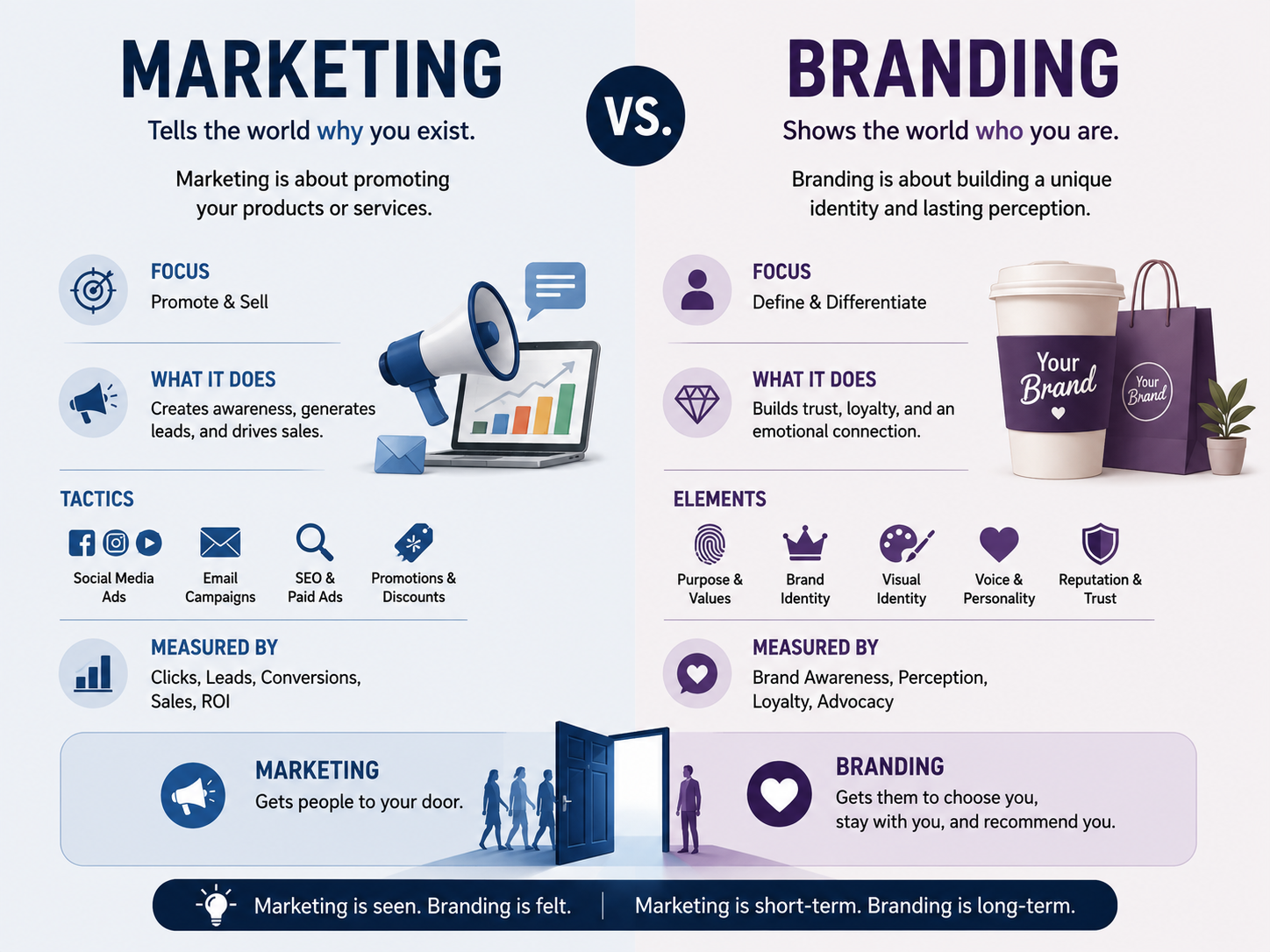
The biggest difference between marketing and branding is their purpose. Branding defines who my business is, while marketing communicates that identity to potential customers. Branding creates perception, whereas marketing creates visibility.
Branding establishes my company’s personality and values before customers make purchasing decisions. Marketing uses various promotional strategies to introduce those customers to my products and encourage them to take action.
Simply put, branding answers the question “Who am I as a business?”, while marketing answers “How do I reach and persuade my customers?”
Marketing vs Branding Comparison Table
| Comparison Factor | Marketing | Branding |
|---|---|---|
| Primary Purpose | Promote products and services. | Create business identity. |
| Main Focus | Customer acquisition. | Customer perception. |
| Objective | Generate sales. | Build trust and loyalty. |
| Time Horizon | Short to medium term. | Long-term. |
| Measures Success By | Traffic, leads, and sales. | Recognition, loyalty, and reputation. |
| Approach | Promotional. | Strategic. |
| Customer Relationship | Attracts customers. | Retains customers. |
| Communication | Campaign-based. | Consistent brand voice. |
| Duration | Campaign-specific. | Continuous. |
| Business Impact | Revenue generation. | Long-term business value. |
Core Elements of Branding
Building a successful brand requires much more than visual design. Every customer interaction contributes to my brand image.
- Brand name
- Logo design
- Brand colors
- Typography
- Mission statement
- Vision and values
- Brand personality
- Brand voice
- Customer experience
- Business reputation
Core Elements of Marketing
Marketing includes numerous strategies that help my business reach customers and generate measurable results.
- Market research
- Search Engine Optimization (SEO)
- Content marketing
- Social media marketing
- Email marketing
- Paid advertising
- Product pricing
- Sales promotions
- Public relations
- Marketing analytics
Why Branding and Marketing are Both Important
Marketing and branding work together to achieve business success. Marketing introduces customers to my business, while branding gives them confidence to choose my products and remain loyal.
Benefits of Branding
- Creates customer trust.
- Builds emotional connections.
- Increases customer loyalty.
- Strengthens competitive advantage.
- Supports premium pricing.
- Improves brand recognition.
Benefits of Marketing
- Generates awareness.
- Drives website traffic.
- Creates qualified leads.
- Increases sales.
- Supports business expansion.
- Measures campaign performance.
Real-World Examples of Branding and Marketing
Branding Example
Suppose I launch an organic skincare company. I create a memorable business name, develop a clean logo, establish environmentally friendly values, define a consistent tone of voice, and provide exceptional customer service. These activities form my brand identity.
Marketing Example
To promote the same skincare products, I publish SEO blog posts, run Google Ads, advertise on Instagram, create YouTube tutorials, send email newsletters, collaborate with influencers, and optimize product pages. These activities represent my marketing strategy.
Advantages of Branding and Marketing
Advantages of Branding
- Creates long-term customer loyalty.
- Builds trust and credibility.
- Increases business value.
- Supports premium pricing.
- Strengthens customer retention.
- Improves market differentiation.
Advantages of Marketing
- Generates new customers.
- Increases revenue.
- Expands market reach.
- Builds online visibility.
- Improves lead generation.
- Provides measurable business insights.
Common Mistakes Businesses Make
- Focusing only on marketing without building a brand.
- Creating inconsistent brand messaging.
- Ignoring customer experience.
- Changing brand identity too frequently.
- Running campaigns without understanding the target audience.
- Neglecting online reputation management.
- Prioritizing short-term sales over long-term loyalty.
- Failing to maintain consistent visual branding.
- Ignoring customer feedback.
- Measuring only sales instead of brand performance.
How Branding and Marketing Work Together
Branding provides the foundation for every marketing campaign. Before I advertise my products, customers should understand who I am, what I stand for, and why they should trust my business.
Marketing communicates my brand through various channels such as search engines, social media, email, paid advertising, websites, and content marketing. Every successful campaign reinforces my brand identity while generating awareness and sales.
When branding and marketing are aligned, customers receive consistent messages, develop stronger trust, and become more likely to recommend my business to others.
Conclusion
Understanding marketing vs branding is essential for building a successful business in today’s competitive marketplace. Although they serve different purposes, they are deeply connected. Branding establishes my company’s identity, personality, values, and reputation, while marketing communicates that identity to the right audience through strategic promotional activities.
Branding creates emotional connections that inspire trust and loyalty, whereas marketing generates visibility, attracts potential customers, and increases sales. Businesses that focus only on marketing may struggle to retain customers, while those that invest only in branding may fail to reach new audiences.
By integrating consistent branding with effective marketing strategies, I can build a recognizable business, strengthen customer relationships, increase market share, and achieve sustainable long-term growth. Rather than choosing between branding and marketing, the most successful organizations treat them as complementary disciplines that work together to create lasting business success.
Frequently Asked Questions
What is the main difference between marketing and branding?
Branding defines my business identity and customer perception, while marketing promotes my products and services to attract and convert customers.
Which comes first: branding or marketing?
Branding generally comes first because it establishes the identity, values, and positioning that marketing communicates to potential customers.
Can marketing succeed without branding?
Marketing may generate short-term sales without strong branding, but long-term customer loyalty and business growth usually depend on a well-developed brand.
Is branding a part of marketing?
Branding and marketing are closely related but distinct. Branding shapes business identity, while marketing uses that identity to communicate with customers and achieve business objectives.
Why do successful companies invest in both?
Strong branding builds trust and recognition, while effective marketing generates awareness, attracts customers, and drives revenue. Together they create sustainable competitive advantages.